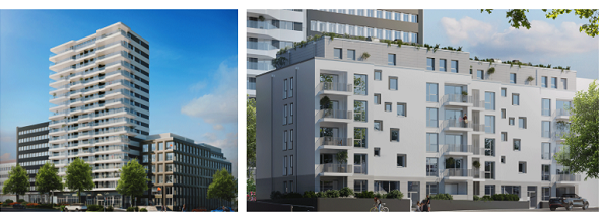

More than €300 million has been invested in Huyssenallee in recent years. Most of the properties have been sold and modernised by their new owners. Particularly striking are the new buildings developed by Stiftung Mercator and the recently completed Huyssen Quartier (HQE), opposite the Philharmonie. It comprises a 60-metre residential tower and four further buildings with commercial and retail space. Brockhoff successfully advised on the sale of the former property on the site and on letting all the commercial space to audit firm PwC.
More than five years ago, Essen property broker Eckhard Brockhoff highlighted the untapped potential of Huyssenallee during a site visit and outlined his vision for the street. “After the visit, I approached the property owners directly and advised them to invest in their buildings. In return, I would find them new tenants within a short time. Many chose to sell instead. We helped with some of those sales too, finding new owners whose willingness to invest and open-mindedness paved the way for Huyssenallee’s 3rd spring,” says Eckhard Brockhoff.
Higher rents are also making Huyssenallee more attractive to investors
Brockhoff OFFICE also arranged numerous further lettings after changes of ownership. Today there is hardly any vacant space on Huyssenallee. The premises have become so sought after that prospective tenants are queuing up.
“Huyssenallee is once again an undisputed 1A location in Essen. Rental trends confirm this. In new buildings, prime rents exceed €16/m². Rents have also risen noticeably in refurbished existing properties. This is a positive signal for buildings that have not yet been renovated: higher rents now make modernisation worthwhile for their owners,” says Eckhard Brockhoff.
Eckhard Brockhoff is convinced that more restaurants would also benefit Huyssenallee. Outdoor dining in particular would encourage people to spend more time there and improve quality of life. This would appeal not only to visitors to the Aalto Theatre and Essen Philharmonie. “Many refurbished existing buildings have been converted for residential use on their upper floors. Now everyday shops and restaurants also need to establish themselves on Huyssenallee. If we succeed, the gap between the lifestyle district of Rü and the main station will be closed, giving Essen another vibrant neighbourhood,” Brockhoff predicts for the boulevard’s future.
A street with a history-rich life cycle
Huyssenallee has a remarkable history. Laid out in the late decades of the 19th century, it was named after Essen merchant Heinrich Arnold Huyssen, whose generous donation of land to the city made its creation possible. Its broad layout and proximity to the city park quickly made it a favoured residential area for the upper middle class. Completely destroyed by bombing in the Second World War, Huyssenallee was rebuilt in 1950s. Banks and insurance companies in particular moved in, turning it into an elegant business address. Around 50 years later, the landscape changed: the insurers first moved to Düsseldorf and then to Frankfurt, leaving one vacant building after another. Office space on upper floors was occasionally re-let, but most buildings remained empty. The successful development of recent years has put this life cycle on a positive course. Huyssenallee in Essen: a grand boulevard through the years.