Ruhr office markets remain stable: Dortmund tops 100,000 m², with Essen close behind
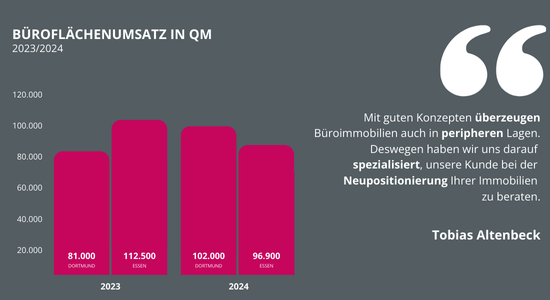
The two largest office markets in the Ruhr region were separated by just over 5,000 m² of take-up. The notable point is that Dortmund, with just over 100,000 m², exceeded its previous year’s result by around 25%, while Essen’s 96,700 m² represented a decline of around 15,000 m² compared with 2023.
A look at tenant sectors shows that the city itself signed four leases totalling around 27,200 m² in Dortmund, while Essen lacked the “usual suspects”. The decline in office leasing therefore came as little surprise to Brockhoff Managing Director Tobias Altenbeck: “In recent years, take-up in Essen was driven above all by corporations, educational institutions and the city itself. Consolidation phases at several corporations in particular meant fewer requirements came to market last year. Demand is now picking up again.”
Vacancy rates need to be considered in light of the condition of the space. Modernisation needs are particularly high in Ruhr office markets, where many buildings were constructed in the 1980s or earlier. Owners’ willingness to invest is becoming the key factor. For agents such as Brockhoff, the role has shifted from simply marketing property to providing comprehensive advice on repositioning buildings. Numerous projects have shown that energy-efficient refurbishments with modern space concepts can be let in full quickly.
In 2024, revitalised properties in prime locations achieved rents of around €18.50/m², matching new-build space. “Last year we signed leases in peripheral locations at more than €16/m² because the property’s new concept was so convincing,” Altenbeck explains.